
Commemorating Black August: Study, Fast, Train, Fight
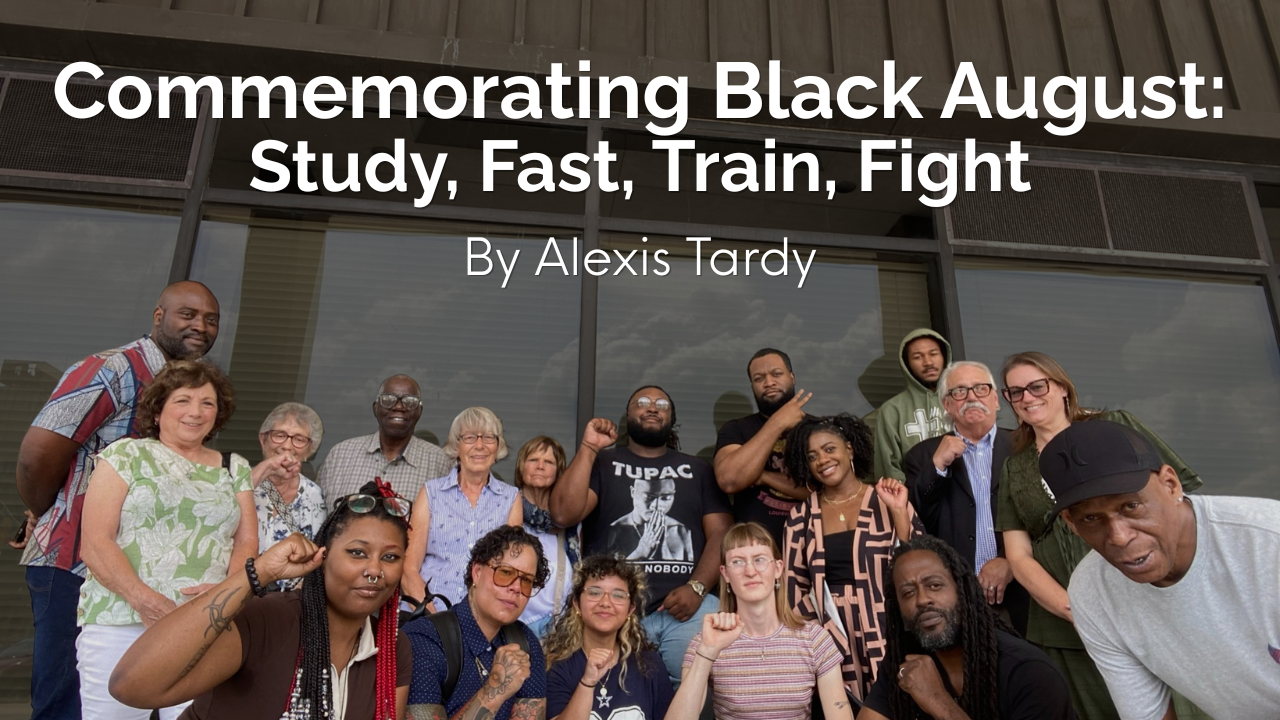
The Defense Committee to Free the Pendleton 2 shows its support for Christopher "Naeem" Trotter at a hearing in Anderson, IN, July 9, 2026.
By Rev. Dr. Alexis Tardy
"August is a month of meaning, of repression and radical resistance, of injustice and divine justice; of repression and righteous rebellion; of individual and collective efforts to free the slaves and break the chains that bind us." - Mumia Abu-Jamal
"The bitter truth is that the Church has permitted the various hate-inspired groups in our common life to establish squatter’s rights in the minds of believers because there has been no adequate teaching of the meaning of the faith in terms of human dignity and human worth." - The Fascist Masquerade, Howard Thurman
"But at midnight Paul and Silas were praying and singing hymns to God, and the prisoners were listening to them. Suddenly there was a great earthquake, so that the foundations of the prison were shaken; and immediately all the doors were opened, and everyone’s chains were loosed." - Acts 16:25-26
Black August is a month set apart to commemorate political prisoners not only of the past, but the present. It is our individual and collective commitment to literally break chains—to respond in solidarity to Jesus' anointing to set the captives free.
Black Alliance for Peace explains the historic nature of Black August in their Black August Toolkit 2026: Censorship and Psychological Warfare:
"Black August is a month of commemoration and commitment. We commemorate the history of the Black Liberation Movement and its partisans—especially those held captive by the U.S. carceral state. And we commit to revolutionary discipline, action, and solidarity to carry that struggle forward.
Black August began in 1979, growing out of the material conditions, revolutionary struggle, and martyrdom of Black political prisoners in San Quentin prison. The month of August has been a time of acute struggle throughout Black revolutionary history.
The following milestones, to name a few, occurred during this month: the beginning of the Haitian Revolution (1791); Nat Turner’s Rebellion (1831); Emancipation Day, in which slavery was abolished in the British empire (1833); the Watts Rebellion (1965); the Soledad Brothers revolt in the Marin County Courthouse (1970); and the assassination of George Jackson (1971)."
In this commitment to collective discipline and struggle against repression and fascism, the four pillars of Black August are Study, Fast, Train, Fight. As people of faith, we have both scripture and this storied history—particularly of Black political prisoners—as grounding resources to gather courage and strategies against injustice and repression in our present moment.
In Acts 16, we witness Paul and Silas traveling from town to town as they shared their ministry on their way to Macedonia. In Phillipi, they gathered with a group of women and met a woman named Lydia, "a dealer of purple cloth." It is believed that Lydia was a businesswoman with significant financial means. She "was a worshiper of God," she and her household were baptized, and she invited Paul and Silas into her home.
However, in what feels like a sudden turn of events in verse 16, we encounter an enslaved woman who was possessed by a spirit and could predict the future. After several days, Paul turned around and rebuked the spirit that possessed the woman. Significantly, those who enslaved this (yet unnamed) woman profited greatly from her fortune-telling. Therefore, when the woman was no longer enslaved by the spirit but set free, the same spirit in the enslavers was agitated.
The spirit of greed was rebuked, and the Roman colonial economic system of exploitation was destabilized. Verse 17 reads this way:
"When her owners realized that their hope of making money was gone, they seized Paul and Silas and dragged them into the marketplace to face the authorities."
The enslavers were specifically upset because Paul and Silas were "throwing [their] city into an uproar" because they were "advocating customs unlawful for us Romans to accept or practice." When liberation is released, the oppressors strike back.
On February 1st, 1985, when John "Balagoon" Cole and Christopher "Naeem" Trotter came to the aid of fellow prisoner Lincoln Love (aka Lokmar Abdul-Wadood), Love was being beaten by prison guards nearly to his death at the Indiana State Reformatory (now Pendleton Correctional Facility). Balagoon and Naeem led the Black Dragons, which was a group of already "politicized fellow inmates"—so that when the moment came to address the guards beating Love nearly to death, they were both disciplined and ready. It was later revealed that the guards were a part of a KKK splinter group called the Sons of Light. There is much more to this story, but through cowardly repercussions for the courageous act of saving their friend's life, Balagoon and Naeem were sentenced to 84 and 142 years in prison. They both spent decades in solitary confinement. As the Defense Committee to Free the Pendleton 2, of which I am a member, seeks to get them home, they are still in prison to this day.
We are often weighed down with what our lane is at this moment—and does what we are doing even matter?
As I was reflecting on a scripture for this blog post, I was admittedly looking for one-person, savior-type scriptures, such as Exodus and Moses. But God led me to this collective text—Paul and Silas needed people along the way with their ministry and as they made their journey. They needed the group of women as they arrived in Phillipi, who I imagine gave them wisdom and strategies as they navigated a new place; or Lydia and her household, who in a sense funded the movement. When Paul and Silas rebuked the spirit that possessed the woman and upset her enslavers and their source of capital, it created an uproar in the entire city. And at midnight, as Paul and Silas sat in prison praying and singing to God, the other prisoners were listening—and suddenly a great earthquake came, so much so that the very foundations of the prison were shaken. Everyone's chains—not just those on Paul and Silas—were loosened and the doors were open.
In other words, healing and disruption are communal. I invite you to fast this Black August—fast in solidarity with the political prisoners who are still fighting. I offer that you might "show yourself approved" by studying, so that we may have the discipline to train and fight against this particular kind of fascism (or rising authoritarianism, if you will), as political prisoners have done and sacrificed their lives for, for generations.
Political prisoners throughout history were not only standing up to the oppressive structural realities that held them captive, they were and are standing up for all of us who stand on the side of justice, and they do it from the belly of the empire. So the next time you, or I, may be wondering whether this struggle is worth it, remember Balagoon, remember Naeem, remember so many others who I cannot name here who are sitting in a cell right now, still believing that justice will have the last word. We have a cloud of witnesses to remind us that it does.
Free them all.
“You must lay your lives on the altar of social change so that wherever you are, there the kingdom of God is at hand.” - Howard Thurman
Support and Donate to Free the Pendleton 2 - https://pendleton2.com/
Learn more about political prisoners - https://thejerichomovement.com/
Rev. Dr. Alexis Tardy (she/her) joined the Alliance staff in 2023 to support the THRIVE cohort. A preacher, educator, and community organizer, Alexis's ministry was profoundly shaped by the Ferguson protests following the death of Michael Brown, Jr. She has devoted her career to advancing racial justice and equipping communities for transformational change. Alexis holds degrees from Indiana University–Purdue University Indianapolis, Eden Theological Seminary, and Memphis Theological Seminary.
